
Heavy salt damage resistance are standardized
The outdoor lighting fixtures featured in the "ZERO" catalogue are compliant with the heavy salt resistance specifications set out in Guide 117: 2010 "Guide to Salt Damage Resistance of Lighting Fixtures and Lighting Poles" by the Japan Lighting Manufacturers Association.
They can be used safely in special environments adjacent to the sea (areas with a salt damage resistance level of [heavy salt resistance]).
Japan Lighting Manufacturers Association Guide 117: 2010 "Guide to salt damage resistance of lighting fixtures and lighting poles" (excerpt)
1. Purpose
In recent years, with the development of port facilities and the expansion of seaside parks, the number of lighting facilities installed near coasts where salt damage is expected is increasing. There are no guidelines showing sufficient measures for lighting fixtures and lighting poles (lighting poles include "arms"; the same applies below) installed in these areas where salt damage is expected, and problems caused by corrosion due to salt damage are increasing, making it necessary to take measures beyond general rust prevention measures, such as surface treatment and material designation.
2. Scope
Corrosion prevention for lighting fixtures and lighting poles requires careful consideration of corrosive gases in heavy industrial areas, snow-melting agents used in winter, and antifreeze agents, but this guide only considers salt damage resistance in coastal areas.
3. Salt damage resistance level
There are two levels of salt damage resistance:
…Our heavy salt damage resistant specifications and surface treatment
a)Heavy salt damage resistance: Level required for areas with high concentrations of salt constantly coming in from the sea
(guideline: range of 0 to 200m from the coast)
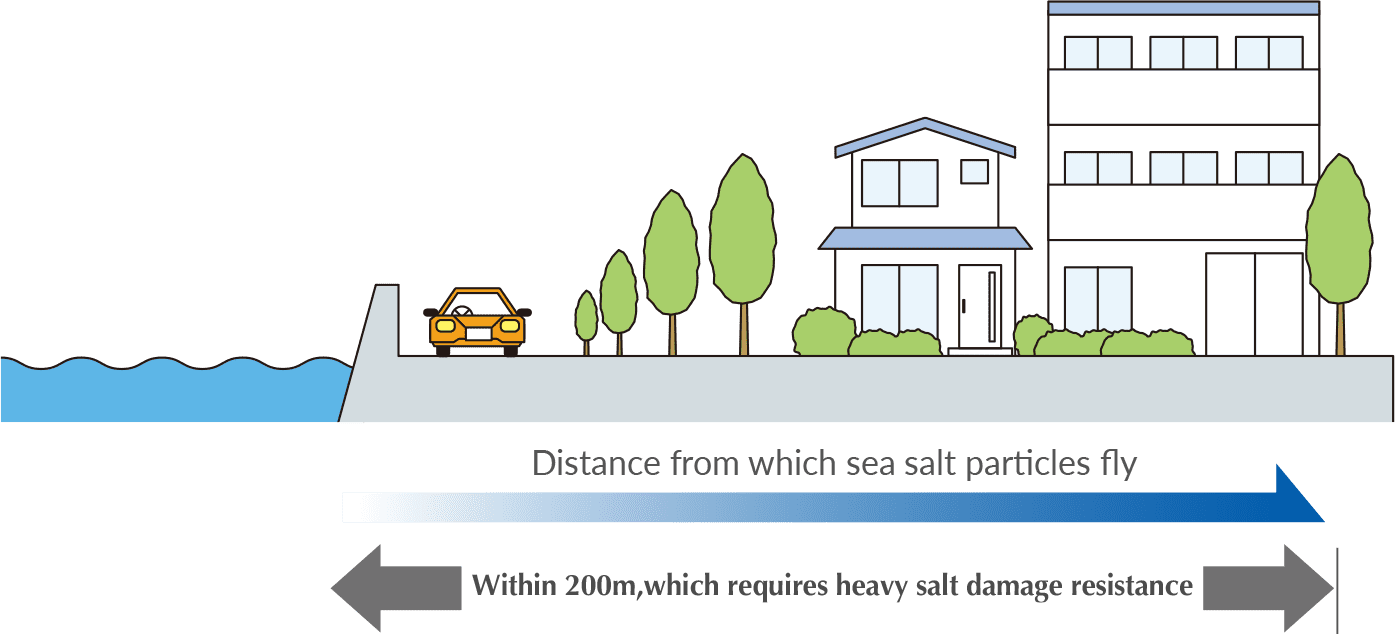
b)Salt tolerance: The level required for areas where salt is constantly blown in and where concentrations can become high due to weather conditions
(guideline: within 200m to 20km of the coast)
The areas to which each level applies cannot be simply delineated based on the distance from the coast. Airborne salt is affected in complex ways by the state of the coastline (open sea, inland sea, harbor, sandy beach, etc.) and height above sea level, so the levels must be determined based on the characteristics of the area. It is recommended that the parties taking delivery of the product discuss and decide on the level, taking into consideration the state of rust on existing surrounding facilities.
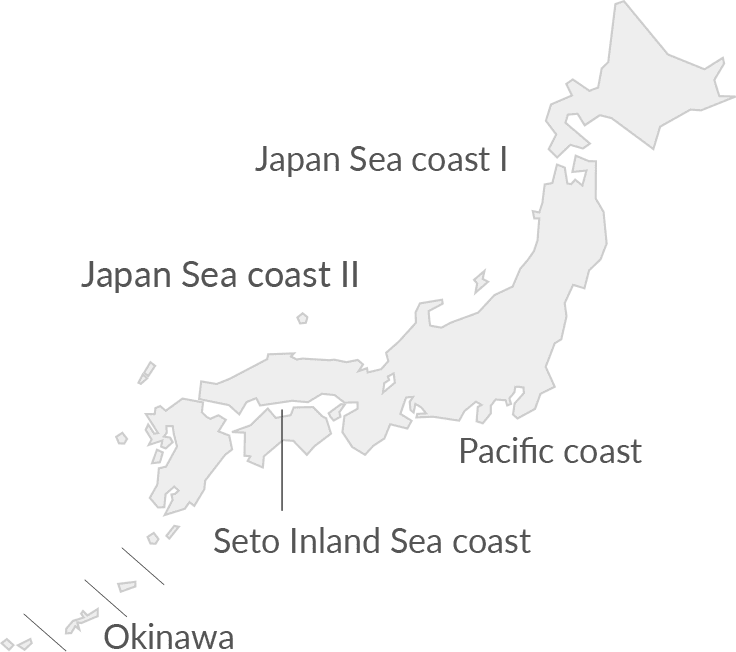
| Area classification | Areas where the amount of airborne salt is thought to affect steel corrosion |
|---|---|
| Japan Sea coastⅠ | Within 20km of the coast |
| Japan Sea coastⅡ | Within 5km of the coast |
| Pacific coast | Within 2km of the coast |
| Seto Inland Sea coast | Within 1km of the coast |
| Okinawa | All Regions |
From the Japan Road Association's "Highway Bridge Specifications and Commentary" (March 2002)
4. Materials and surface treatment
- The surface treatment for the materials of the lighting fixtures and lighting poles to be used should be selected appropriately taking into consideration the properties of the paint shown in Table 1.
- The materials and surface treatments for lighting fixtures and lighting poles to be used in areas expected to be affected by salt damage should be selected from Tables 2 and 3 depending on the level of salt damage in the area in which they will be installed.
- The topcoat paints shown in Tables 2 and 3 are used for painting the exterior of enclosed lighting fixtures and the exterior of lighting poles.
- The surface preparation has a large influence on the ability of topcoat paint to make the most of its properties. To obtain properties corresponding to the salt damage resistance levels of the paints shown in Tables 2 and 3, it is necessary to carry out surface preparation appropriate for the paint.
- For the paints shown in Table 1, the level of salt damage resistance can be significantly affected by the film thickness and number of coats. Tables 2 and 3 list the recommended coating specifications for each material, but it is desirable for the parties involved to decide on the level of salt damage resistance required in the actual usage environment.
5. Construction and maintenance methods
- If the equipment is installed in an area adjacent to the sea, such as under an overpass where it is not exposed to rainwater, the saltwater droplets that adhere to the equipment will not be washed away by rainwater, which may accelerate corrosion. Regular cleaning should be carried out to wash away the salt.
- Since the ground-level parts of lighting poles are prone to corrosion, it is advisable to take measures to prevent water leakage, such as by bringing the base above ground level and creating a slope.
- Any scratches that occur during transportation, installation or use will be repaired promptly by painting.
- Care should be taken to ensure that the concrete aggregate in the lighting pole foundation does not contain salt.
6. Other points to note about salt damage
- For open-type lighting fixtures, measures should be considered to prevent deterioration of insulation in sockets and other parts due to salt accumulation.
- In sealed lighting fixtures, the material of the gasket for the parts that are opened and closed during maintenance such as lamp replacement and cleaning should be selected with consideration given to weather resistance.
- In areas that are subject to salt damage and overlap with heavy industrial zones, chemical resistance must also be taken into consideration.
- Bolts used in joints should be hot-dip galvanized bolts or SUS304 or higher.
Table 1. Salt-resistant paint properties
…Our heavy salt damage resistant specifications and surface treatment
| Paint symbol |
Material name | Painting method |
Lighting fixtures |
Poles | Salt tolerance |
Chalking | Gloss retention |
Hardness of the coating |
Costs | Pole repainting interval |
|---|---|---|---|---|---|---|---|---|---|---|
| A | Acrylic resin paint | Burn-in | ● | ● | ◎ | ◎ | ○ | ◎ | Medium | 7 to 10 years |
| B | Polyurethane resin paint | Burn-in | ● | ● | ◎ | ◎ | ○ | ◎ | Medium | 7 to 10 years |
| Dry | ● | ◎ | ◎ | ○ | ○ | Medium | 7 to 10 years | |||
| C | Polyester resin-paint | Burn-in | ● | ● | ◎ | ◎ | ○ | ◎ | Medium | 7 to 10 years |
| D | Epoxy modified melamine resin paint | Burn-in | ● | ○ | ◎ | △ | ◎ | Medium | - | |
| E | Fluorine resin paint | Burn-in | ● | ● | ☆ | ☆ | ☆ | ◎ | High | 15 to 20 years |
| Dry | ● | ☆ | ☆ | ☆ | ○ | High | 15 to 20 years | |||
| F | Acrylic silicone resin paint | Burn-in | ● | ● | ☆ | ◎ | ◎ | ◎ | Medium | 7 to 10 years |
| Dry | ● | ◎ | ◎ | ◎ | ○ | Medium | 7 to 10 years | |||
| G | Phthalic acid resin paint | Dry | ● | △ | △ | △ | △ | Low | 3 to 5 years |
The meaning of the symbols is as follows: ●: Applicable ☆: Excellent ◎: Excellent ○: Good △: Acceptable
- In addition to rust prevention, gloss retention and chalking are particularly important when installing in parks and other locations where appearance is important. (Chalking is the phenomenon in which the painted surface loses its gloss and becomes clay-like. It is also known as chalking.)
- The hardness of the coating must be taken into consideration when installing the product in a location where sand and other materials are constantly blown in by wind from the sea.
- Regarding costs, they are expressed as a guideline only, as they are affected not only by the cost of painting materials but also by the process, the condition of the equipment, etc.
- Generally, lighting fixtures with baked-on paint are rarely touched up after installation, and it is assumed that they will end up in a service life of 10 years without any touch-up paint, so the repainting period was set only for the poles. (Service life refers to the period during which they can be used without any functional or safety problems even if rust occurs.)
Table 2. Materials and surface treatments of lighting fixtures
…Our heavy salt damage resistant specifications and surface treatment
| Salt damage resistance level | Materials for lighting fixtures | Surface treatment (Paint symbols in Table 1) |
Remarks | |
|---|---|---|---|---|
| Heavy Salt Damage Resistance | SUS304 | A, B, C, E or F | For solvent-based paints, a two-coat bake is recommended. | |
| Aluminum alloy | ADC、AC | A, B, C, E or F | For solvent-based paints, a two-coat bake is recommended. | |
| Plates, shapes, etc. | A, B, C, E or F | For solvent-based paints, a two-coat bake is recommended. | ||
| Steel | After hot dip galvanizing: A, B, C, E or F |
|||
| Hot-dip galvanizing | In places where higher rust prevention performance is required, we recommend painting after hot-dip galvanizing. | |||
| (General) Salt Damage Resistance |
SUS304 or SUS430 | A、B、C、D、E or F | ||
| Aluminum alloy | ADC・AC | A, B, C, E or F | ||
| Plates, shapes, etc. | A、B、C、D、E or F | |||
| Coating materials | Unpainted | Anodized or equivalent coating. | ||
| Steel | Treated steel | A、B、C、D、E or F | Galvanized steel or equivalent coating. | |
| Steel | After hot dip galvanizing: A、B、C、D、E or F |
|||
| Hot-dip galvanizing | In places where higher rust prevention performance is required, we recommend painting after hot-dip galvanizing. | |||
| Steel Plate | A、B、C、D、E or F | In the case of solvent-based paints, two coats of baking paint shall be applied. | ||
Table 3. Materials and surface treatments for lighting poles
…Our heavy salt damage resistant specifications and surface treatment
| Salt damage resistance level | Materials for lighting fixtures | Surface treatment (Paint symbols in Table 1) |
Remarks | |
|---|---|---|---|---|
| Heavy Salt Damage Resistance | SUS316 or SUS304 | A, B, C, E or F | SUS316 is recommended for places where higher rust prevention performance is required. | |
| Aluminum alloy | A, B, C, E or F | |||
| Steel a) | After hot dip galvanizing: A, B, C, E or F |
|||
| (General) Salt Damage Resistance |
SUS304 | A, B, C, E or F | ||
| Aluminum alloy | A, B, C, E or F | |||
| Steel a) | After hot dip galvanizing: A、B、C、E、F or G |
|||
| Hot-dip galvanizing | In places where higher rust prevention performance is required, we recommend painting after hot-dip galvanizing. | |||
Note a) The surface treatment of tapered poles installed on roads, plazas, etc. shall be in accordance with JIL 1001 "Tapered poles for lighting (steel)".